
Why do we develop forecasts and for whom are they intended?
Developing accurate forecasts for charging infrastructure is essential for governments and policymakers to anticipate future needs and support sustainable mobility. We predict the growth of EVs and charging points, which aids in planning public spaces and ensuring sufficient charging capacity. In doing so, we contribute to a smooth transition to electric transport and support local and regional authorities in achieving their sustainability objectives.
Which sources do we use and why are they relevant?
Our forecasts are based on socio-economic data sources. We consider, among other things:
- CBS: For demographic insights to determine a socioeconomic trend, with particular relevance to middle and high-income households;
- RDW: For up-to-date vehicle information and registrations, considering the registration location of electric lease vehicles;
- Kadaster: For accurate location data and ownership information concerning residential properties, utility buildings, and public facilities;
- BGT: For the uniform registration of physical objects in public spaces, including buildings, roads, water bodies, rail infrastructure, and green spaces;
- LISA: The employment register, which determines the number of commuters per region.
By combining this data, a comprehensive picture of the current situation and the anticipated growth in charging demand is created.
Methodology and Principles
The forecast is constructed from a combination of statistical data, scenario analyses, and the spatial distribution of supply and demand. In this, we consider:
- User Groups: In the forecast, we consider
- residents: income levels, housing numbers, vehicle ownership, and the availability of private chargers;
- commuters: employment, travel behavior, and the proportion of car users;
- visitors: location characteristics of facilities, parking standards, and area.
- Distribution of Charging Demand: In the forecast, a distinction is made between:
- the public domain: on-street charging points that are always accessible;
- the semi-public domain: charging facilities at, for example, businesses, sports clubs, or supermarkets that are partially accessible;
- the private domain: charging options at homes or on private property.
Spatial Granularity: Forecasts are developed at a granular level (e.g., 250-meter hexagons) to better inform local policy.
The Result
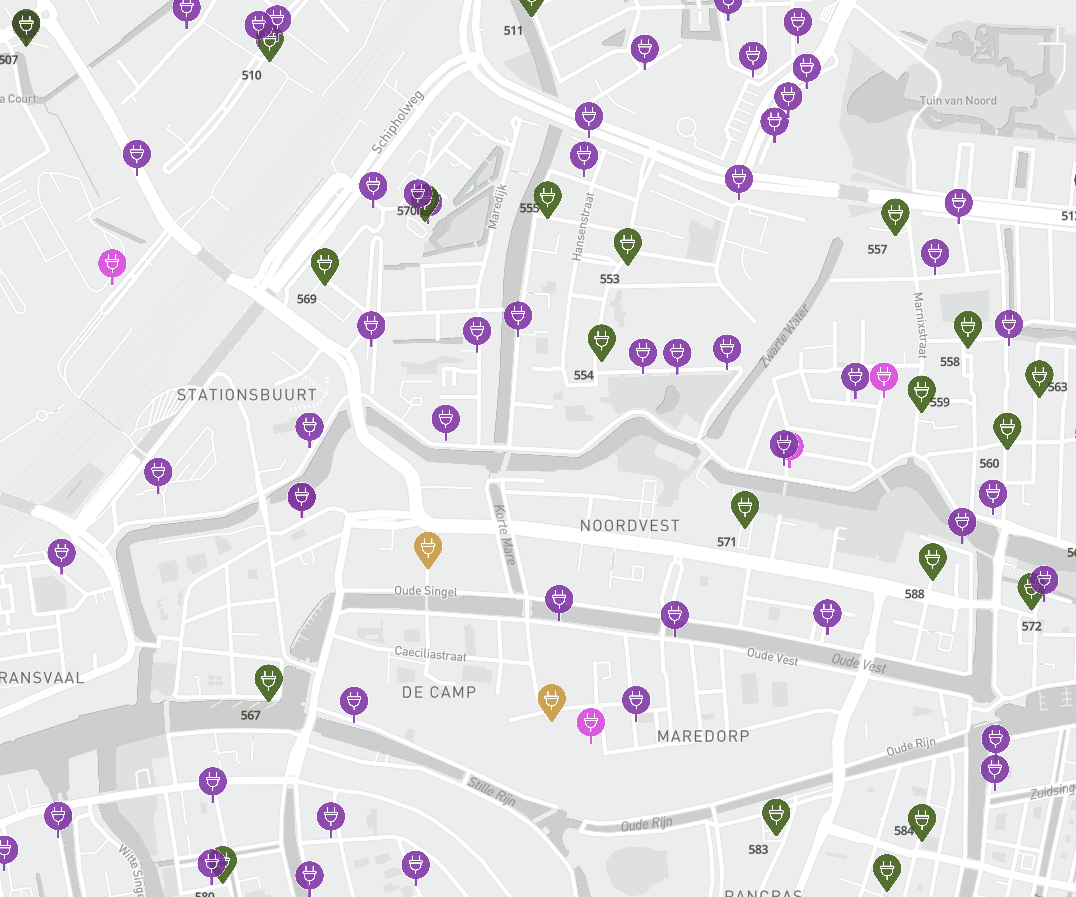
The forecasts are integrated into the EVMaps mapping environment, providing insight into the projected number of electric vehicles and charging points per area:
- The total number of EVs per year;
- The distribution per user group;
- The extent to which charging stations will be shared among groups.
The results are used to develop planning maps, combining the forecast with policy objectives, existing infrastructure, and current consumption data. This creates a concrete implementation plan for the expansion of public charging facilities.