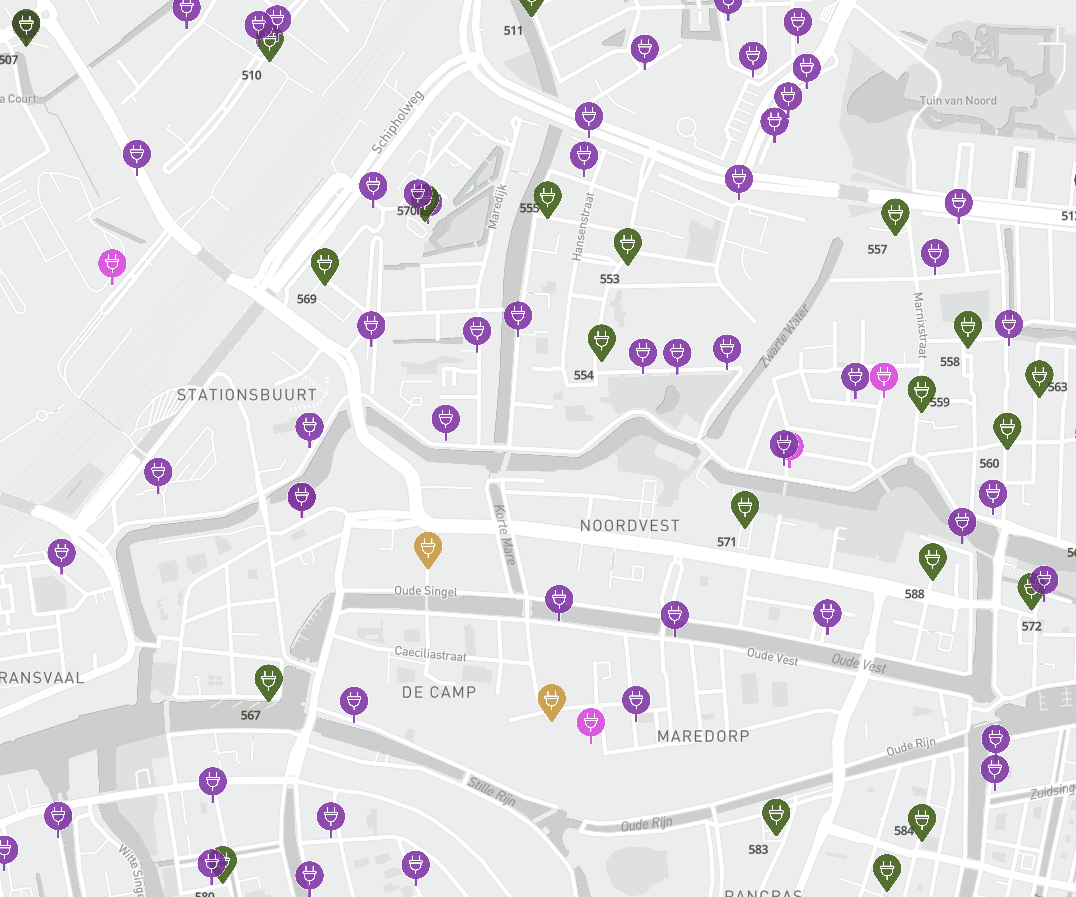

Utilize your existing infrastructure for faster deployment of charging points. Do you have unused capacity on your connections? Or a lighting network that can be combined with charging? Leverage your existing infrastructure for faster deployment of charging points.
The scaling up of charging infrastructure requires smart, innovative solutions from municipalities. Leveraging existing infrastructure can be decisive in this regard. By linking municipal data layers, such as the lighting grid or proprietary connections, to a platform like EVTools, it becomes clear where charging points are logical, technically feasible, and economically justifiable.
Below are two practical examples demonstrating how municipalities can take faster and smarter steps using their data.
Combined Lighting and Charging
In some municipalities, such as Arnhem, experiments have been conducted with combining charging points and lampposts in the Schuytgraaf district. This does not simply involve reusing the existing connection; rather, a new, heavier connection is installed, and the object is replaced.
The business case becomes particularly attractive when lampposts need to be renewed anyway, for instance during scheduled replacement cycles (approximately once every 40 years).
Why Data Layers are Crucial Here:
By uploading the municipality's GIS and asset data into EVTools, insights are gained into the location of lampposts relative to parking spaces, traffic flows, and potential business cases.
The municipality, landowner, and operators can then collaboratively determine within a single platform where lighting and charging are advantageous, what the possibilities are, and how the rollout can be automated.
Municipal Connections as an Alternative
In other municipalities, such as Rotterdam, research has explored how existing municipal connections – from gyms, bridges, and sewage pumping stations – can be utilized for charging infrastructure.
These connections often have residual capacity and are also located close to logical charging sites.
Why Data Layers are Crucial Here:
By combining connections, technical data (such as available capacity and connection type), and parking information within GIS, a comprehensive overview is created.
Within EVTools, municipalities and operators can utilize these layers to:
- Quickly identify suitable locations,
- Assess the business case per connection,
- Automate the initiation of necessary traffic decisions and processes.
This clarifies where municipal connections can be intelligently utilized to accelerate charging infrastructure deployment, without the constant need for new grid connections.
📚 The NKL study “Guideline ‘Alternative Charging’ electric transport” confirms this potential: existing connections can offer an efficient and sustainable solution for scaling up charging infrastructure in specific situations. You can read this study here.
The Power of Integration: From Data to Implementation
Both examples illustrate a common theme: municipalities that actively deploy their data layers gain a clear advantage. Whether it concerns grid objects being renewed or residual capacity from existing connections – the key lies in combining spatial, technical, and process data within a single platform.
With EVTools APIs, municipalities can directly link their own GIS systems, thereby accelerating collaboration with market parties.
The Key to Acceleration
Leveraging existing infrastructure not only offers municipalities opportunities for cost savings and acceleration but, more importantly, enables smarter management of the charging transition.
Arnhem and Rotterdam demonstrate that this is achievable, provided data is centralized and effectively made accessible to all involved parties.
One thing is clear: those who utilize their data layers can react more swiftly!
📞 Want to know more?
Get in touch with our team!