
Need for better forward planning with up-to-date data and good internal cooperation
Reason and background research
On February 25, 2025 EVTools organized a special webinar for Flemish cities and municipalities. This webinar focused on improving the use of software and data for planning charging locations, optimizing cooperation between involved parties and making decisions based on up-to-date and transparent data about the charging network. EVTools has been providing both planning and process software to support the Department of Mobility and Public Works (MOW) concession since 2022. To get a better idea of the challenges and needs within Flemish cities and towns, 12 questions were posed to participants during the webinar. A total of 48 local governments participated in this survey. These insights not only help to better understand the current situation, but give municipalities concrete tools for the further development of their charging network.
Summary of conclusions
The study shows that Flemish municipalities have a great need for up-to-date data and independent insight into charging infrastructure, but that usage data are still hardly used for the expansion of the charging network. Decision-making and administrative processes could be more efficient through better cooperation and automation. Municipalities prefer strategic placement of charging stations based on a potential map, rather than just placement on demand. KPIs on realization processes and data are essential for policy making, but these insights are often lacking. Finally, uncertainty about the future number of operators creates ambiguity in the market, making sustainable oversight of own charging network difficult. In this report, we explore these findings and their implications for the further development of charging infrastructure. The goal of this study is to translate these insights into practical solutions and recommendations that can contribute to a more effective approach. By sharing the results with policy makers such as MOW and local governments and involved parties such as charge point operators and the Association of Flemish Cities and Municipalities, we want to contribute to making future tenders more responsive to the needs of local governments.
Survey results
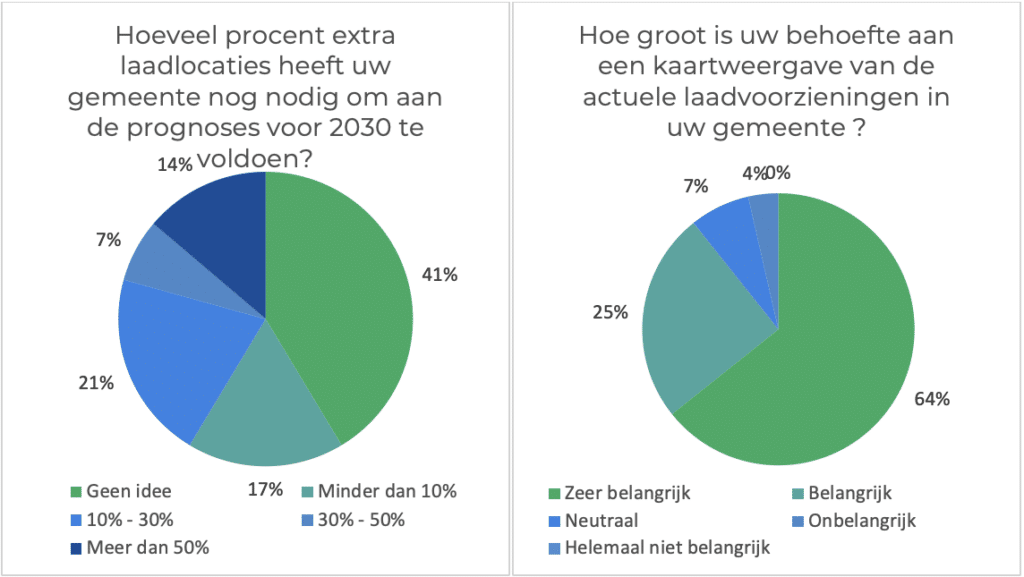
Flemish cities and municipalities face a major challenge in the rollout of charging infrastructure, but lack the right insights to effectively plan the needed expansion. The results show that 41% of municipalities lack sufficient insight into the expected expansion towards 2030. The variation in projected growth by municipality highlights that there is no unified view, making it difficult for policymakers to make strategic choices.
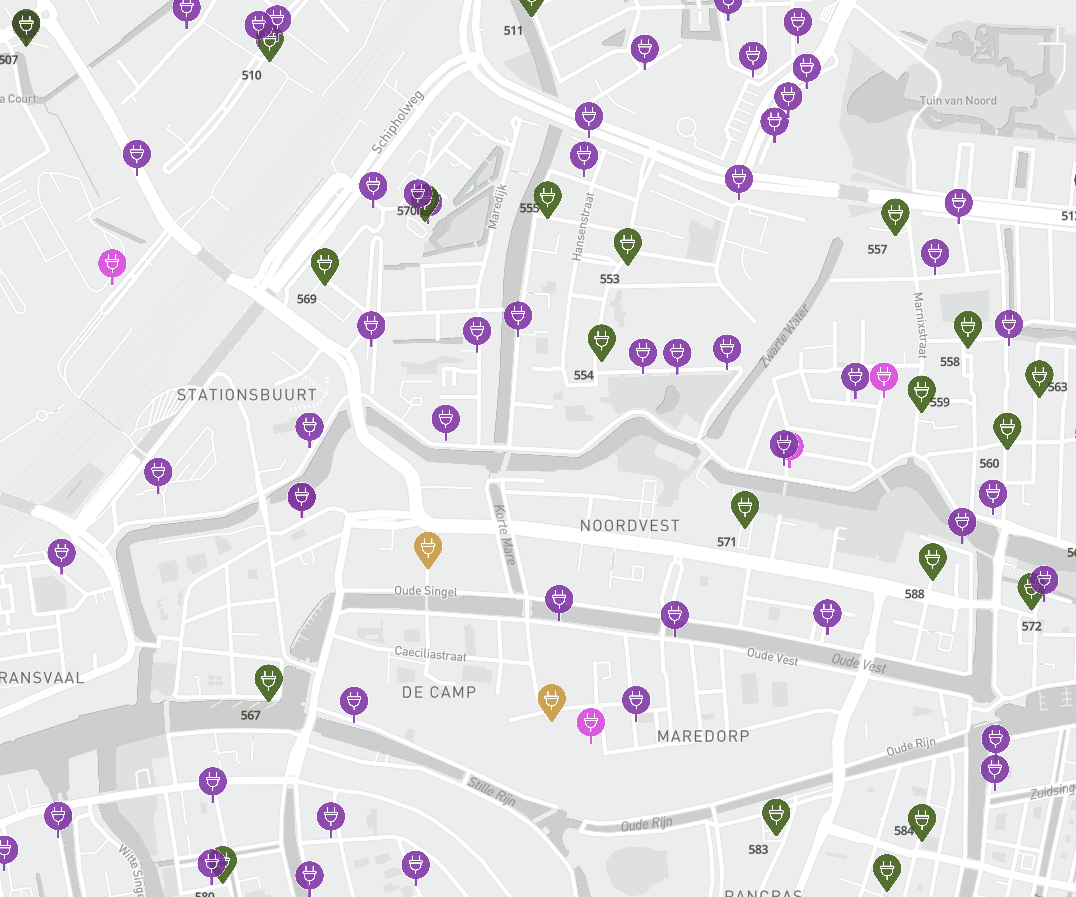
At the same time, we see a strong need for a clear map display of current charging infrastructure: 64% of municipalities consider a map display of this very important and 25% important. This suggests that municipalities want to better integrate location data into their own (GIS) systems or make it accessible to residents as an information service. In addition, this need underscores the importance of a data-driven approach. Decision making and planning can improve significantly with a platform that provides real-time insight into the status and progress of charge location expansion.
While municipalities increasingly want to create a strategic plan, they often lack the right tools to do so effectively. Potential maps with pre-planned future charging locations are an important basis for data-driven planning, but many municipalities struggle to implement them. A majority of municipalities (56%) would like to create a potential map but do not know how to do so. This indicates a need for support to develop these maps. In addition, 26% of municipalities already have a potential map for internal use, indicating a growing acceptance of planning, but suggesting that there is still reluctance to share the potential map. Only 18% see no need for a potential map, possibly because they have limited charging needs on public property.
Many Flemish municipalities use little data when expanding their charging networks. This is evidenced by the fact that only a small percentage use potential maps with dynamic, real-time preferred locations. 60% of municipalities never use this data, 20% use it rarely and the remaining 20% sometimes.
Most municipalities place great importance on internal collaboration when choosing charging locations, but do not always have the right tools to organize this efficiently. The survey shows that 83% of municipalities consider it very important or important that colleagues help decide on future charging locations. Only a small minority (3%) consider it unimportant. This highlights the need for a structured internal validation process, where relevant data on proposed locations is widely accessible to municipal decision-makers.
Unlike internal cooperation, external cooperation with residents seems to play a less decisive role in accelerating the rollout of charging stations. A large proportion of municipalities never or occasionally experience delays due to objections from residents. This may indicate that residents are often not involved in decision-making beforehand, or that they do not object when a charging station is placed in their neighborhood without explicit communication. Municipalities indicate that broader participation does not directly lead to a faster rollout. This suggests that transparent communication mainly contributes to support, rather than to process acceleration.
Whereas resident participation hardly causes delays, administrative procedures appear to be a greater obstacle to the rollout of charging infrastructure. In 73% of municipalities, an addition to the traffic regulations takes more than 15 minutes, while 9% indicate it takes between 5 and 15 minutes. This shows that automation of such processes can be valuable to municipalities. Interestingly, 18% indicate they do not have time for this, which may indicate a lack of capacity or priority.
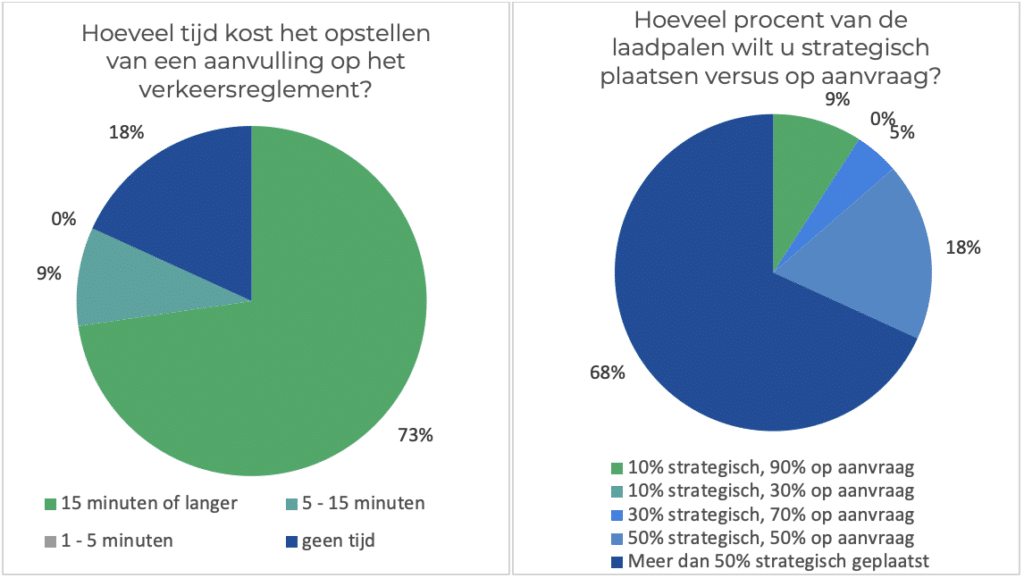
Municipalities want more control over the placement of charging stations and are betting on strategic rather than reactive rollout. A large majority of the municipalities (68%) indicate that they want to place more than 50% of the charging points strategically. Strategic placement means that charging points will be installed proactively on the basis of usage data ("pole follows pole"), municipal policy and forecasts, while placement will be on demand when a specific user requests a charging point ("pole follows car").
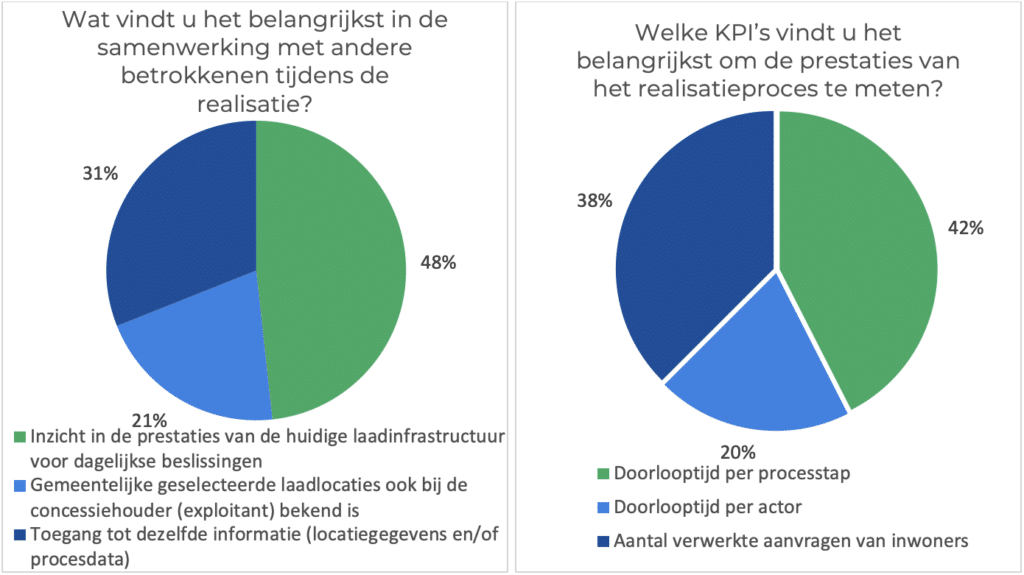
While municipalities increasingly want to strategically manage charging infrastructure, they often lack the right data and transparency. For 48% of respondents, insight into the performance of current charging infrastructure is crucial, as it helps them manage charging points more efficiently and report more easily. In addition, 31% think it is important that all parties involved have access to the same information, such as location data and process data. A smaller proportion (21%) emphasize that it is essential that municipally selected charging locations are also known to the concessionaire. Interestingly, 80% of respondents filled in more than 1 answer, suggesting that municipalities find multiple aspects important in collaboration.
Although local governments want to be data-driven, the right insights into the charging station realization process are often lacking. The most important measure for 42% of municipalities is lead time per process step. In addition, 20% consider lead time per actor a relevant indicator, while 38% look at the number of resident requests processed. That 55% of respondents tick multiple indicators shows that municipalities value a broad set of performance metrics. This underscores the need for an independent and transparent reporting system for monitoring charging station realizations.
Municipalities are not only looking for ways to make the charging station process more efficient, but also to improve its documentation and accountability. For example, 39% of municipalities indicate that photos of the street are considered valuable information when delivering a charging station. In addition, 32% consider it important to understand the reason for cancellation of a completion process, as this helps improve future processes. Finally, 29% want to know which installer installed a charging station, indicating the need for better recording and accountability of historically realized sites, independent of the contractor. This highlights the importance of having transparent and independently documented information about charging station realizations.

While municipalities want to plan more strategically, they often lack insight into how the market will evolve and which operators will remain active, which can have direct implications for how they manage their charging infrastructure. There is much uncertainty about the future degree of concentration in the charging market, or the amount of parties that will be active in public charging within a specific territory, such as a municipality. This determines not only the degree of competition, but also the contractual and operational manageability of the municipal charging network. 48% of municipalities report that they cannot make a clear estimate of the number of operators in 2030. Of those that do try, 31% expect a market in which three operators are active for public charging, one for semi-public and one for fast charging. A smaller proportion expect a more diverse distribution with four to five operators. A greater diversity of operators may result in each operator using its own software tool, leaving municipalities without a central overview. This complicates the management and comparison of data on charge points, usage and performance within one portal. The study does not directly reveal the extent to which municipalities that want to work data-driven consider this a risk. However, it is clear that fragmented systems and different operator portals make obtaining an up-to-date and integrated overview more complex.